Spain goes to home after two disappointing matches!
Chile reaches the second round of the world cup!
Australia 2 - 3 Holland
Holland dreams the final in Rio de Janeiro!
mercoledì 18 giugno 2014
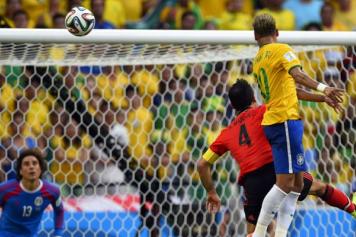
Mexico 0 - 0 Brazil
The surprises aren't finished!!
lunedì 16 giugno 2014
The 2014 FIFA WORLD CUP has opened with important matches and many surprises!!
It's the official 2014 FIFA WORLD CUP song: "We are one"!!
mercoledì 28 maggio 2014
MANCHESTER UNITED'S ACCIDENT IN 1958 This article
is about the 1958 crash of the aircraft carrying the Manchester United football team. For the 1960
accident, see 1960 Munich Convair 340 crash.
The Munich
air disaster occurred on 6 February 1958 when British European Airways flight 609
crashed on its third attempt to take off from a slush-covered runway
at Munich-Riem Airport, West
Germany. On the plane was the Manchester Unitedfootball team, nicknamed the "Busby Babes",
along with supporters and journalists. 20 of the 44 on the aircraft died. The
injured, some unconscious, were taken to the Rechts der Isar Hospital in Munich where three more
died, resulting in 23 fatalities with 21 survivors. The football team was returning
from a European Cup match in Belgrade, Yugoslavia (now Serbia) against Red
Star Belgrade. The flight stopped to refuel in Munich
because a non-stop flight from Belgrade to Manchester was out of the
"Elizabethan" class Airspeed Ambassador aircraft's range. After
refuelling, pilots James Thain and Kenneth Rayment twice abandoned take-off because
of boost surging in the left engine. Fearing they would get too far behind
schedule, Captain Thain rejected an overnight stay in Munich in favour of a third take-off attempt.
By then, snow was falling, causing a layer of slush at the end of the runway.
After the aircraft hit the slush, it ploughed through a fence beyond the end of
the runway and the left wing was torn off after hitting a house. Fearing the
aircraft might explode, Thain began evacuating passengers while Manchester
United goalkeeperHarry Gregg
helped pull survivors from the wreckage. An investigation by West German
airport authorities originally blamed Thain, saying he did not de-ice the
aircraft's wings, despite eyewitness statements to the contrary. It was later
established that the crash was caused by slush on the runway, which slowed the
plane too much to take-off. Thain was cleared in 1968, ten years after the
incident. Manchester United were trying to
become the third club to win three successive English league titles; they were
six points behind League leaders Wolverhampton Wanderers with 14 games
to go. They also held the Charity Shield and had just advanced into
their second successive European Cup semi-final. The team had not
been beaten for 11 matches.
Aircraft
and crew
The aircraft was a six-year-old Airspeed Ambassador 2, built in 1952 and
delivered to BEA the same year.[citation needed] The co-pilot, Captain Kenneth
Rayment, was a former RAF flight
lieutenant and Second World Warflying ace.
After joining the RAF in 1940, he was promoted to sergeant in
September 1941. He was commissioned as a war substantive pilot
officer a year later, and promoted to war substantive flying
officer in May 1943. He shot down five German fighters, one Italian plane
and a V-1 flying bomb. He was awarded the DFC in July 1943, and
promoted to flight lieutenant in September 1943. After leaving the RAF in 1945,
he joined BOAC in Cairo, before joining BEA in 1947. He had had
experience with Vikings, Dakotas and the Ambassador Elizabethan
class. The pilot, Captain James Thain,
was also a former RAF flight lieutenant. Also originally a sergeant (later a
warrant officer), he was given an emergency commission in the RAF as an acting
pilot officer on probation in April 1944, and promoted to pilot officer on
probation in September. He was promoted to flight lieutenant in May 1948,and
received a permanent commission in the same rank in 1952. He retired from the
RAF to join BEA.
Crash
The Airspeed
Ambassador G-ALZU burning at Munich
Thain had flown the
"Elizabethan" class Airspeed Ambassador (registration G-ALZU) to Belgrade but handed the
controls to Rayment for the return. At
14:19 GMT, the control tower at Munich
was told the plane was ready to take off and gave clearance for take-off,
expiring at 14:31. Rayment abandoned the take-off after Thain noticed the port boost
pressure gauge fluctuating as the plane reached full power and the engine
sounded odd while accelerating. A second attempt was made three minutes later,
but called off 40 seconds into the attempt because the engines were running on
an over-rich mixture, causing them to over-accelerate, a common
problem for the Elizabethan. After the second failure, passengers retreated to
the airport lounge. By then, it had started to snow heavily, and it looked
unlikely that the plane would be making the return journey that day. Manchester
United's Duncan Edwards sent a telegram to his landlady in Manchester. It read:
"All flights cancelled, flying tomorrow. Duncan."
The Airspeed
Ambassador wreckage
Thain told the station engineer,
Bill Black, about the problem with the boost surging in the port engine, and
Black suggested that since opening the throttle more slowly had not worked, the
only option was to hold the plane overnight for retuning. Thain was anxious to
stay on schedule and suggested opening the throttle even more slowly would
suffice. This would mean that the plane would not achieve take-off velocity
until further down the runway, but with the runway almost 2 kilometres
(1.2 mi) long, he believed this would not be a problem. The passengers
were then called back to the plane 15 minutes after leaving it. A few of the players were not
confident fliers, particularly Liam
Whelan, who said, "This may be death, but I'm ready". Others,
including Duncan Edwards, Tommy Taylor, Mark Jones, Eddie
Colman and Frank Swift, moved to the back of the plane, believing
it safer. Once everyone was on board, Thain and Rayment got the plane moving
again at 14:56. At 14:59, they reached
the runway holding point, where they received clearance to line up ready for
take-off. On the runway, they made final cockpit checks and at 15:02, they were
told their take-off clearance would expire at 15:04. The pilots agreed to
attempt take-off, but that they would watch the instruments for surging in the
engines. At 15:03, they told the control tower of their decision.
American newsreel
footage reporting the crash
Rayment moved the throttle
forward slowly and released the brakes; the plane began to accelerate, and
radio officer Bill Rodgers radioed the control tower with the message
"Zulu Uniform rolling". Throwing up slush as it gathered speed, Thain
called out the plane's velocities in 10-knot increments. At 85 knots, the port
engine began to surge again, and he pulled back marginally on the port throttle
before pushing it forward again. Once the plane reached 117 knots (217 km/h), he
announced "V1", at which it was no longer safe to abort
take-off, and Rayment listened for the call of "V2" (119
knots (220 km/h)),
the minimum required to get off the ground. Thain expected the speed to rise,
but it fluctuated around 117 knots before suddenly dropping to 112 knots (207 km/h), and
then 105 knots (194 km/h).
Rayment shouted "Christ, we won't make it!", as Thain looked up to
see what lay ahead. The plane skidded off the end of
the runway, crashed into the fence surrounding the airport and across a road
before its port wing was torn off as it caught a house, home to a family of
six. The father and eldest daughter were away and the mother and the other
three children escaped as the house caught fire. Part of the plane's tail was
torn off before the left side of the cockpit hit a tree. The right side of the
fuselage hit a wooden hut, inside which was a truck filled with tyres and fuel,
which exploded. Twenty passengers died on board, and there were three
subsequent deaths. On seeing flames around the
cockpit, Thain feared the aircraft would explode and told his crew to evacuate
the area. The stewardesses, Rosemary Cheverton and Margaret Bellis, were
the first to leave through a blown-out emergency window in the galley,
followed by radio officer Bill Rodgers. Rayment was trapped in his seat by the
crumpled fuselage and told Thain to go without him. Thain clambered out of the
galley window. On reaching the ground, he saw flames growing under the starboard
wing, which held 500 imperial gallons (2,300 L) of fuel. He shouted to his
crew to get away and climbed back into the aircraft to retrieve two handheld
fire extinguishers, stopping to tell Rayment he would be back when the fires
had been dealt with.
Meanwhile, in the cabin, goalkeeperHarry Gregg
was regaining consciousness, thinking that he was dead. He felt blood on his
face and "didn't dare put [his] hand up. [He] thought the top of [his]
head had been taken off, like a hard boiled egg."[ Just above him, light shone into the cabin, so
Gregg kicked the hole wide enough for him to escape. He also managed to save
some passengers.
WEMBLEY STADIUM The original Wembley Stadiumofficially known as the Empire Stadium, was a footballstadium in Wembley, London, England, standing
on the site now occupied by the New
Wembley Stadium that opened in 2007. It was famous for hosting the
annual FA Cup
finals, five European Cup finals, the 1948 Summer Olympics, the 1966 World Cup Final, the final of Euro 96, Queen's Magic Tour, and the 1985 Live Aid concert. Of Wembley Stadium, Pelé said,
"Wembley is the cathedral of football. It is the capital of football and it
is the heart of football in recognition of its status as the world's best-known
football stadium. The twin towers were an icon for
England and Wembley and their demolition in 2003 upset many members of the
public Debris from the Old Wembley Stadium was used to make the award-winning Northala
Fields in Northolt, Ealing.
The stadium's first turf was cut
by King George V, and it was first
opened to the public on 28 April 1923. First known as the British Empire
Exhibition Stadium or simply Empire Stadium, it was built by Sir
Robert McAlpine for the British Empire Exhibition of 1924
(extended to 1925). The stadium cost £750,000,
and was constructed on the site of an earlier folly called Watkin's
Tower. The architects were Sir John Simpson and Maxwell
Ayrton and the Head Engineer Sir Owen Williams. It was originally
intended to demolish the stadium at the end of the Exhibition, but it was saved
at the suggestion of Sir James Stevensona
Scot who was
chairman of the organising committee for the Empire Exhibition. The ground had
been used for football as early as the 1880s At the end of the exhibition, an
entrepreneur Arthur Elvin (later to become Sir Arthur Elvin)
started buying the derelict buildings one by one, demolishing them, and selling
off the scrap. The stadium had gone into liquidation, after it was pronounced
"financially unviable Elvin offered to buy the stadium for £127,000, using
a £12,000 downpayment and the balance plus interest payable over ten years. After complications following the
death of James White the original Stadium owner, Elvin bought Wembley Stadium
from the new owners, (Wembley Company) at the original price, since they
honoured Elvin's original deal. They then immediately bought it back from
Elvin, leaving him with a healthy profit. Instead of cash he received shares,
which gave him the largest stake in Wembley Stadium and he became chairman. The electric scoreboard and the
all encircling roof, made from aluminium and translucent glass, were added in
1963.
The stadium's distinctive Twin
Towers became its trademark and nickname. Also well known were the
thirty-nine steps needed to be climbed to reach the Royal box and collect a
trophy (and winners'/losers' medals). Wembley was the first pitch to be
referred to as "Hallowed Turf", with many stadia around the world
borrowing this phrase. In 1934, the Empire
Pool was built nearby. The 'Wembley Stadium Collection' is held by the National Football Museum. The stadium
closed in October 2000, and was demolished in 2003 for redevelopment.
The top of one of the twin towers was erected as a memorial in the park on the
north side of Overton Close in the Saint Raphael's Estate
WEMBLEY STADIUM IN TWENTIETH CENTURY
WEMBLEY STADIUM INSIDE
WEMBLEY STADIUM OUTSIDE
HOOLIGANISM
Early usage
The first use of the term is unknown, but the word first appeared in print in London police-court reports in 1894 referring to the name of a gang of youths in the Lambeth area of London—the Hooligan Boys, and later—the O'Hooligan Boys.
In August 1898 a murder in Lambeth committed by a member of the gang drew further attention to the word which was immediately popularised by the press. The London-based newspaper Daily Graphic wrote in an article on 22 August 1898, "The avalanche of brutality which, under the name of 'Hooliganism' ... has cast such a dire slur on the social records of South London".
Arthur Conan Doyle wrote in his 1904 novel The Adventure of the Six Napoleons, "It seemed to be one of those senseless acts of Hooliganism which occur from time to time, and it was reported to the constable on the beat as such". H.G. Wells wrote in his 1909 semi-autobiographical novel Tono-Bungay, "Three energetic young men of the hooligan type, in neck-wraps and caps, were packing wooden cases with papered-up bottles, amidst much straw and confusion".
According to Life magazine (30 July 1941), the comic strip artist and political cartoonist Frederick Burr Opper introduced a character called Happy Hooligan in 1900; "hapless Happy appeared regularly in U.S. newspapers for more than 30 years," a "naive, skinny, baboon-faced tramp who invariably wore a tomato can for a hat." Life brought this up by way of criticizing the Soviet U.N. delegate Yakov A. Malik for misusing the word. Malik had indignantly referred to anti-Soviet demonstrators in New York as "hoolgans." Happy Hooligan, Life reminded its readers, "became a national hero, not by making trouble, which Mr. Malik understands is the function of a hooligan, but by getting himself into it."
Modern usage
Later, as the meaning of the word shifted slightly, none of the possible alternatives had precisely the same undertones of a person, usually young, who belongs to an informal group and commits acts of vandalism or criminal damage, starts fights, and who causes disturbances but is not a thief.
More recently, the term hooligan has started to be used in a constructive sense, to describe people who are dissatisfied with the status quo and decide to challenge it through radically innovative efforts to either disrupt or re-invent the models that guide our lives, in collaboration with like-minded individuals across traditional boundaries.
An excellent example is the liberal/progressive, crowd-sourced political blog based in Asheville, North Carolina, which adopted the name "Scrutiny Hooligans" in 2004.
Violence in sports
The word hooliganism and hooligan began to be associated with violence in sports, in particular from the 1970s in the UK with football hooliganism. The phenomenon, however, long preceded the modern term; for example, one of the earliest known instances of crowd violence at a sporting event took place in ancient Constantinople. Two chariot racingfactions, the Blues and the Greens, were involved in the Nika riots which lasted around a week in 532 CE; nearly half the city was burned or destroyed in addition to tens of thousands of deaths.
THERE ARE ALSO SOME FILMS ABOUT
HOOLIGANISM
It's the trailer of "Green street hooligans", good vision!
mercoledì 7 maggio 2014
Premier League,Crystal Palacev Liverpool3-3.And the titlegoes away


 Manchester City
 Liverpool
 Chelsea
 Arsenal
 Everton
 Tottenham
 Manchester Utd
 Southampton
 Stoke City
_bordato_Oro.svg) Newcastle
Newcastle Crystal Palace
 Swansea City
 West Ham
 Sunderland
_con_leone_Giallo.svg) Aston Villa
Aston Villa.PNG) Hull City
Hull City West Bromwich
 Norwich City
 Fulham
 Cardiff City